Skip to content
View in the app

A better way to browse. Learn more.

PalmTalk

A full-screen app on your home screen with push notifications, badges and more.

To install this app on iOS and iPadOS
  1. Tap the Share icon in Safari
  2. Scroll the menu and tap Add to Home Screen.
  3. Tap Add in the top-right corner.
To install this app on Android
  1. Tap the 3-dot menu (⋮) in the top-right corner of the browser.
  2. Tap Add to Home screen or Install app.
  3. Confirm by tapping Install.

WELCOME GUEST

It looks as if you are viewing PalmTalk as an unregistered Guest.

Please consider registering so as to take better advantage of our vast knowledge base and friendly community.  By registering you will gain access to many features - among them are our powerful Search feature, the ability to Private Message other Users, and be able to post and/or answer questions from all over the world. It is completely free, no “catches,” and you will have complete control over how you wish to use this site.

PalmTalk is sponsored by the International Palm Society. - an organization dedicated to learning everything about and enjoying palm trees (and their companion plants) while conserving endangered palm species and habitat worldwide. Please take the time to know us all better and register.

guest Renda04.jpg

A Tale of Two Coccothrinax miraguamas
Featured Replies

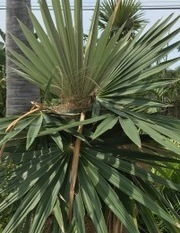
Here's some 'not so subtle' differences in Cocco. miraguama varieties. Even though from a little distance, they look very similar, their are very distinct differences. 

First of all, C. miraguama var. havanensis is a bit more robust and faster growing, but that could just be in my yard. The seeds on this thing are gigantic, as big as I've ever seen on a Cocco. And when they are cleaned of the fruit, still at least 3-4 times larger than the (roseocarpa). Then there's the trunk fiber, very thick, and free at the top. (First two Photos)

The next two photos show C. miraguama var. roseocarpa. Seeds are small, and even tiny when fruit is cleaned off. The fiber strands are neatly finished off on top with a little border. And finally the two mature trees almost the same size. Incidentally, the two palms have slightly different shaped leaves, with var. roseocarpa's being more round and circular than var. havanensis. 


IMG_0364.JPG

IMG_0366.JPG

IMG_0361.JPG

IMG_0365.JPG

IMG_0354.JPG

IMG_0356.JPG

Warrior Palm Princess, Satellite Beach, Florida

Thanks for post here this good info and for the nice pictures.

I love Coccothrinax genus!

  • Author

Thanks, Cocco's have always been my favorite genus of all time.

Warrior Palm Princess, Satellite Beach, Florida

  • Author

I forgot to post the last pic. Although some of the 'roseocarpa' seeds seem no good, many are, as you can see the one cut open on the right with embryo showing. The larger one cut open on left is 'havanensis'  I think I'll plant a few this year and see.

IMG_0367.JPG

Warrior Palm Princess, Satellite Beach, Florida

Create an account or sign in to comment

Account

Navigation

Configure browser push notifications

Chrome (Android)
  1. Tap the lock icon next to the address bar.
  2. Tap Permissions → Notifications.
  3. Adjust your preference.
Chrome (Desktop)
  1. Click the padlock icon in the address bar.
  2. Select Site settings.
  3. Find Notifications and adjust your preference.